Ultimately,
I would say that relational aesthetics is a plea for the extension of
the human realm, in a world which is de-humanizing itself at high
speed.:Nicolas Bourriaud
Theorist Nicolas Bourriaud interviewed by M K harikumar
1]
''But we should not be mistaken, there's no medium which is more
interesting by itself than another one. By our time, an artist who
belongs completely to his/her time can draw pictures with ballpoint
pens, while another one using the Internet will produce an old thought.
Fortunately, what constitutes the show here is not the medium…''
please explain.
[ I corrected this passage in my own words, which makes it clearer ]
It
is not by using such or such tool or medium that you are contemporary.
And by « contemporary » (like in « contemporary art »), I mean an art
which corresponds and answers to its time. An artist is contemporary to
the production system he/she is living in. And this production system
is irrigating every possible medium, contemporary or not : painting,
even if it is an archaic way to produce forms, can tell us many things
about the world we live in, our nervous systems, our ways of thinking.
That is why I try not to turn technology into a fetish.
2]How do you define an art or art practice?
The
only definition I always stuck to is the following : art is an
activity consisting in producing relations to the world, using signs,
forms or images as a base. Whatever you do as an artist, the only
remaining element is this one : you show something, in one way or
another, and somebody else (the « beholder ») will respond to it.
3]Is art work mechanic?
No more, but no less, than you and me.
4] What is spontaneity ?
To
attain real spontaneity, you need a lot of practice. As a judoka, if
you want to be spontaneous during a fight, you need to rehearse over
and over. What people call « spontaneity » is nothing more than the
pavlovian gesture of repeating our habits ; to get rid of the numerous
layers of learnt elements that occupy our brains, we all need to avoid
spontaneity. If we want to reach the new, we have to kill this robotic
spontaneity.
5] Do you find artistic originality?
Hopefully
yes. But my job consists in finding the originality within an artwork
that looks like something we have seen before. Sometimes, moving your
own point of view brings you amazing results.
6] How do you differ the notions of sensibility and identity?
Sensibility
is a part of myself as a human being ; identity, according to me, is
only another name for the cultural pressure provided by the community.
Identity is about groups, nations, totems and passports ; it is related
to the notion of belonging, whilst your sensibility has been
elaborated by your experience, from the neuro-physical facts you were
born with. It is related to « being ». To write it differently, and
take a precise example, I would say that among the indian casts, the
untouchables have today can more easily than others build a proper
sensibility, because their identity as a group has been erased or
denied. Beyond an identity, we have to build our consciousness, and it
comes from our path, more than from our background.
7]What is alter modernism?
The
altermodern is the hypothesis of a 21st century modernity, based on
the specificities of our times, and not on the elements that
constituted the modernism of the 20th century. Among the notions that
seem to be crucial for this new modernity, globalisation is the main
one. Against the modernist « progress », this modernity claims the
diversity of local time-spaces and the general form of the archipelago;
rather than a linear vision of time and the insistence on the future,
it designates the past as a territory to be explored ; rather than
being a western esperanto, like 20th century modernism, the altermodern
is a practice of cultural translation. For the first time ever, there
is now a possibility for a really planetarian movement — not only an
american-european trend adapted to other coutries, but the birth of a
non-symetrical thought, beyond the binary system (colons/colonized,
north/south, etc…) that emprisons postmodern thought.
8]What is relational aesthetics?
First
of all, an essay published in 1998, which tried to determinate the
common points between the artists of my generation I was interested of,
from Maurizio Cattelan to Gabriel Orozco, from Dominique
Gonzalez-Foerster to Pierre Huyghe, etc… it appeared soon that for them,
the sphere of human relations played the same role as the realm of
consumption did amongst the pop art generation. So I defined relational
art as « a set of artistic practice taking as a point of departure the
sphere of human interactions », either to produce social situations or
to use them as an element of composition in an artwork. This
problematics was actually dominant in the last two decades, because it
corresponds to the reification of human relationships in a globalised,
profit-oriented world. Ultimately, I would say that relational
aesthetics is a plea for the extension of the human realm, in a world
which is de-humanizing itself at high speed. That is what modern art was
about : isn’t impressionnism the thriumph of the hand, the visible
brush stroke?
9]How do you differentiate the terms like post modernism and relational or alter modernism.
Relational
art is the name I invented to describe the emergence of a new
problematics in visual arts. As I said, Altermodernism is another term I
coined, to describe the possibility of a new way of thinking : it is
more general, and it designates a work in progress, somehow. Both terms
are actually war machines against post-modernism. I consider now the
prefix « post » as the biggest handicap we have to find new solutions
to our problems. I don’t want to live anymore in a « post » everything
culture…
10] You had used the words 'cultural nomad'.what will be the effect of writing in the contemporary world
I
am radicant, not radical : it means that I grow my roots through
meetings, encounters, travels. I am not rooted anymore. More precisely, I
can grow my roots wherever I want. Writing is a path, too.
11] 'Every new technology affects the art of its era and creates new thinking zones, fields...' please explain?
I
will take an example : the apparition of internet, at the beginning of
the 1990’s, made us think differently. We could think in terms of
networks, direct communication, creation of communities… It played an
important role, indeed, in the emergence of what I called « relational »
art, but it did not happen directly on the internet.
12]'The contemporary culture has also no center..' , is this applicable to writing?
Of
course. But when William Faulkner invents the county of Yoknapatawpha,
he talks both about his immediate surroundings and a universal place.
When Borges writes about a specific neighborhood in Buenos Aires, he is
universal too. Nomadism does not mean abstraction, and the absence of
center, maybe it is a paradox, reinforces the idea of the local.
13]'Today
the finished product or work of art is opposed, protested by these
new applications...' is a poem or short fiction come under this
vision?
Yes, I think so. Poems or stories can be fragments of a moving totality.
16]Is
a novelist a centre of his work, capable of creating a theme ,
constructing an environment of authority? And 17] How much importance
you give to writer's uniqueness? how can interpret a work of art on the
basis of its aesthetic originality?
I cannot interpret an
artwork otherwise. My main criterion is the artwork’s ability to
provide a unique vision of the world, a new set of problematics or an
original problematization of the world, even a tiny part of it.
18] Is there any relevance to aesthetics.?
Aesthetics
is, first of all, the « logos » of the gaze : a discourse on the way
we can apprehend the visible. In the contemporary world, it has even
become wider : it gathers whatever escapes to the quantifiable. I
really believe we are reaching the age of aesthetics.
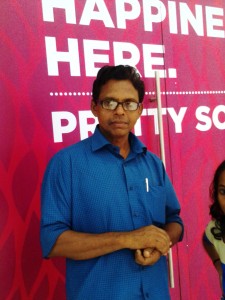 |
| എം .കെ .ഹരികുമാർ |


